
Piezo, A Targeted Solution for Stubborn Pain
If you’ve been dealing with pain that just won’t go away despite rest, stretching, or other treatments, the problem may be more than simple soreness.
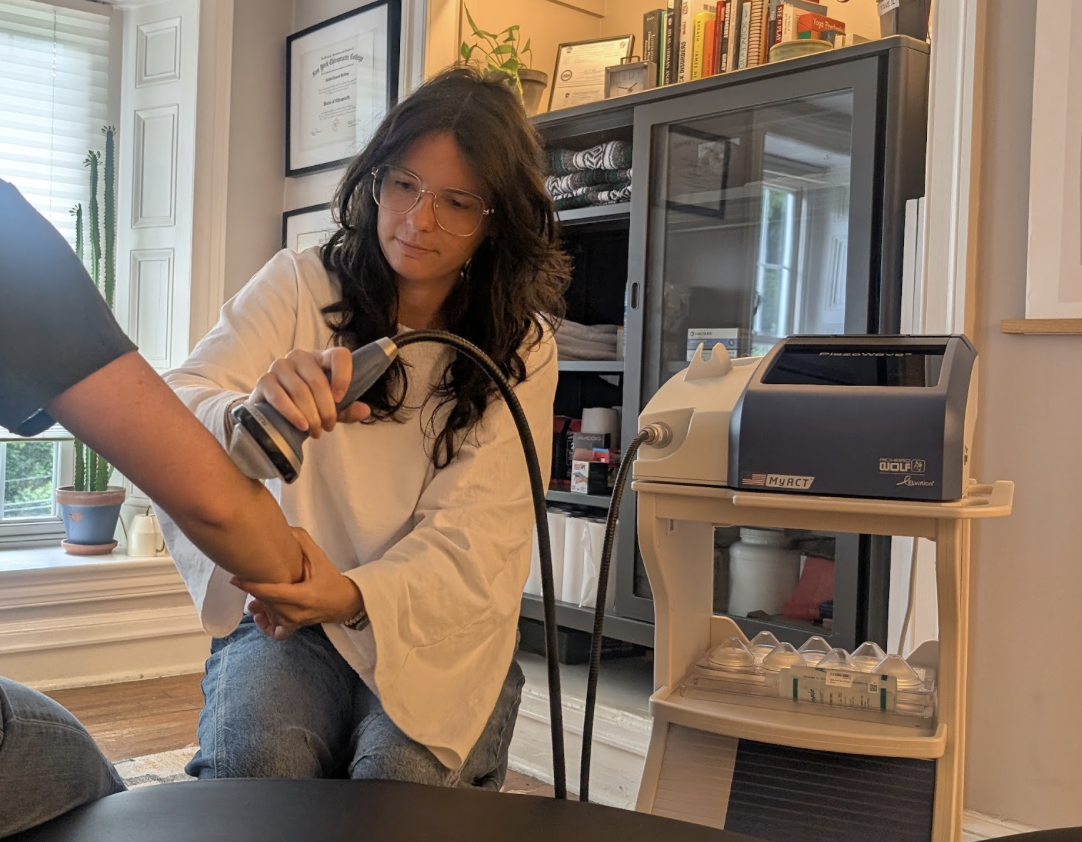
Lateral or Meidal Epicondylitis
Tendons and other soft tissues can be slow to heal, particularly when an injury has become chronic. Piezo shockwave therapy gives us a non-invasive way to target these stubborn areas and encourage the body’s natural repair response.
aPiezo shockwave therapy uses focused acoustic waves to deliver mechanical energy into a specific area of tissue. Unlike injections or surgical procedures, there are no needles or incisions, and treatment typically requires no downtime.
Because the energy can be precisely targeted, we can concentrate treatment on the tissue that needs attention without treating a broad surrounding area.
How Does It Work?
The acoustic waves create a controlled mechanical stimulus within the tissue. This can promote biological responses associated with circulation, tissue remodeling, and repair.
Shockwave therapy is particularly interesting in chronic tendon problems because these conditions don’t always behave like a fresh injury. Instead of simply waiting for inflammation to settle, the goal is to stimulate change within tissue that has remained painful or dysfunctional over time.
It can also be used in certain conditions involving calcification, such as calcific tendinopathy of the shoulder.

Tendonitis or Stenosing Tenosynovitis
What Can We Treat?
We commonly consider shockwave therapy for stubborn musculoskeletal conditions such as plantar fasciitis, Achilles and patellar tendinopathy, tennis or golfer’s elbow, and certain types of chronic shoulder pain.
It isn’t appropriate for every painful condition, which is why determining what tissue is actually causing the problem matters before beginning treatment.
What Does Treatment Feel Like?
A typical session is relatively quick, often lasting around 10–15 minutes. Most patients describe a tapping or pulsing sensation over the treatment area, with some tenderness when we reach the tissue causing the problem.
The intensity can be adjusted throughout the session based on your comfort and the area being treated.
Some people notice a change in their symptoms shortly after treatment, while others improve gradually over a series of sessions. Mild soreness afterward can occur and usually feels similar to post-exercise soreness.
Not All Shockwave Therapy Is the Same
“Shockwave therapy” is an umbrella term, and not every device works the same way.
Many treatments marketed as shockwave use radial pressure waves, which deliver their strongest energy at the surface and spread outward into the tissue. This can be useful for more superficial areas, but it is different from focused shockwave technology.
Piezo shockwave uses focused acoustic energy that can be directed to a specific depth and treatment area. This allows us to more precisely target the tissue we want to reach while minimizing unnecessary energy to the surrounding area.
That precision can be especially valuable for chronic tendon problems, deeper tissues, and certain calcifications—allowing us to deliver treatment where it’s needed most and help you get back to moving comfortably again.
How Does It Fit Into Chiropractic Care?

Chronic Knee Pain
Pain doesn’t always come from one structure. A joint may not be moving well while the muscles or tendons surrounding it are also irritated or overloaded.
That’s why we may combine shockwave therapy with chiropractic care when appropriate. An adjustment can address joint mechanics, while shockwave allows us to directly target the involved soft tissue.
Rather than chasing the painful spot alone, we can look at how the joint and surrounding tissues are functioning together.
Is Shockwave Therapy Right for You?
If pain has lingered for weeks or months, keeps returning, or hasn’t responded the way you expected to rest and conservative care, it may be worth looking at the problem differently.
Shockwave therapy isn’t the answer for every condition, but for the right patient and the right tissue, it can be a valuable tool.